THE IRON ARK The Evidence They Had to Destroy
If people realise that their ancestors were destroyed, they will understand that they live in an occupied world where degradation occurs instead of development.
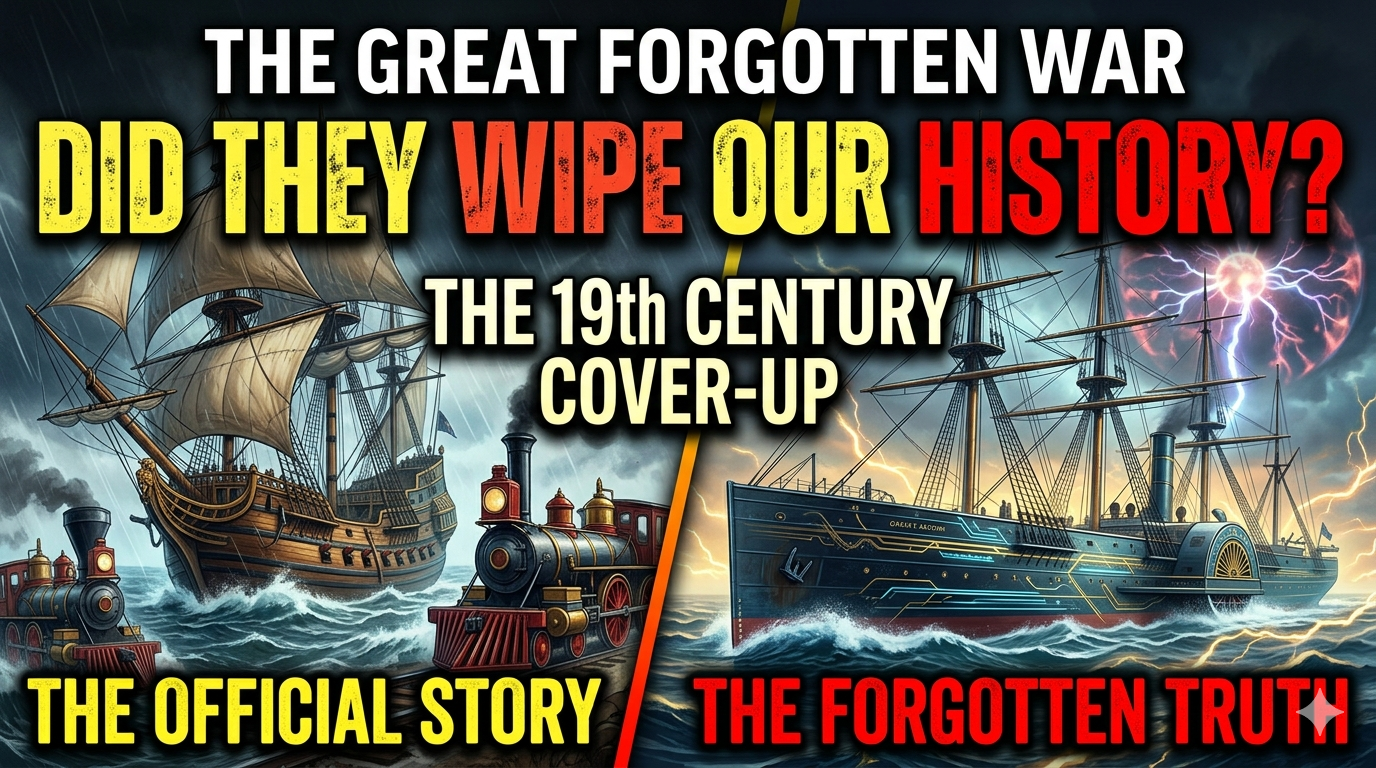
Imagine you are a victor in a brutal war of annihilation that has just erased entire cities from the face of the earth. Chronicles are burned, witnesses are terrified, and the ruins are still smoldering, awaiting your explanation of what happened. Before you stand the remnants of cyclopean structures and traces of weaponry of such power that cannot be attributed to cannonballs and muskets. If people realise that their ancestors were destroyed, they will understand that they live in an occupied world where degradation occurs instead of development. One gesture and you declare a total cleansing. The ruins are buried, complex mechanisms are melted down, and genocide is labeled as local colonial conflicts of savages. What will you choose?


Watch the full video - produced by PastLies
Read the full text..
What will you choose? To preserve the memory of the real tragedy and risk an uprising, or to invent a story about peasant antiquity so that against the backdrop of fictional savagery, your rule appears as the peak of civilization.
II. Anomalies of the Industrial Revolution
Now let's see how it looked in real history. Take a school textbook, the section on the 19th century, the Industrial Revolution, locomotives, telegraphs, metallurgy, steel bridges. All of this seems to have emerged from nowhere in just 50 years. Yesterday people rode horses by candlelight, and today they build skyscrapers and launch transatlantic steamships. Doesn't it seem to you that something is wrong here?
Look at Stevenson's first locomotive. This is not a primitive cart with a boiler. This is a complex system with precise tolerances, with pressure of several atmospheres, with mechanisms that require an understanding of thermodynamics. Where are the experiments? Where are the generations of engineers who should have arrived at such complexity through trial and error? They simply do not exist. It is as if someone opened a hanger with ready-made blueprints and said, "Copy."
III. The Problem of Industrial Scale
Count for yourselves to create an industry from scratch. Decades of training for masters are needed. Years of trial and error. Mountains of scrap metal from failed experiments." But we see the opposite. In the 18th century, Europe is illuminated by candles, and by the mid 19th century, entire cities are suddenly flooded with electric light.
This is not evolution. This is inventory. Someone found what had already been created before them, disassembled it into parts, and launched it into production under their own names. The official history explains this by genius loners and scientific breakthroughs. Fine. Then where are their notebooks with calculations? Where are the thousands of pages of experiments that must precede each discovery? The blueprints look like copies from earlier sources that supposedly did not exist.
IV. The Steel Giants of the 19th Century
The strangest finds were not on land. They floated. Take a look at the ship Great Eastern, launched in 1858. It is an all-metal behemoth nearly 200 meters long, with a double hull, watertight compartments, and welding and riveting of such quality that the seams held for a century and a half without repair.
Now open a picture of any wooden galleon from the 17th or 18th century. What do you see? Primitive planks held together by ropes and resin. Supposedly, it was on such clumsy tubs that Columbus crossed the Atlantic, and Magellan circumnavigated the globe. Do you really believe in this fairy tale?
V. A Question of Metallurgical Capability
Let's count honestly. To build a single metal ship like the Great Eastern, thousands of tons of high-quality iron are needed. Where are the factories capable of producing such a volume? Officially, in the mid 19th century, metallurgy was just starting to get on its feet. Blast furnaces were a rarity, coal was expensive, and skilled blacksmiths could be counted on one hand.
But the ship exists. Moreover, there were dozens of such ships all over the world. Where did the steel come from? Where did the machines for cutting multi-ton sheets come from? Where did the technology for airtight riveting come from, which even today not every shipyard can replicate without computer control? There is no answer. There is only a beautiful legend about British self-taught engineers.
VI. Reverse Evolution: From Complex to Primitive
Here is what truly undermines the official version. The evolution of technology goes from simple to complex. First a raft, then a boat, then a sailboat, then a steamboat. That is what schools teach.
But if you look at the quality of execution, the picture turns upside down. Metal ships of the mid 19th century are technologically more advanced than what is being built today. Their hulls did not rust for decades. Their mechanisms worked without failures. Their structures withstood storms of such strength that modern vessels sink. This is not progress. This is degradation. We are looking at the remnants of technologies that were created by someone else and trying to copy them, losing quality with each generation.
VII. The True Purpose of the Iron Giants
But these iron giants could not sail simply on sails. Look at their design. They do not have masts of the necessary height. They do not have rigging of such size they could move a hundred thousand ton behemoth against the wind. Therefore the purpose was different.
VIII. Global Synchronized Cleansing
The ships were weapons. The 19th century is called the era of colonial wars. But look at the map of conflicts. These are not disparate skirmishes. This is a synchronized cleansing of the planet.
IX. Case Studies: Crimea, Paraguay, and China
The Crimean War, a coalition of Britain, France, and Turkey, sends gigantic fleets to the Black Sea to besiege a single city for years: Sevastopol. Why? The official version about control over the straits is ridiculous. Such concentration of naval power for a single port is absurd from a military point of view, unless the goal was completely different.
Look at the Paraguayan War. A small country in the heart of South America against a coalition of three neighbors. The result? 90% of the male population of Paraguay was destroyed. 90%. This is not war. This is genocide. And the main role was played by river fleets, which penetrated deep into the continent and methodically erased cities from the face of the earth.
Or take China. Officially, there was the Taiping Rebellion. Peasants with pitchforks allegedly killed 100 million people. But anyone who looks at photographs of the destroyed Chinese cities of that time will see not traces of fires, but ruins reminiscent of carpet bombing. Who possessed such power in the mid 19th century? The answer is simple. The Navy. Ships entered the mouths of rivers, sailed upstream, and opened fire.
X. The Mechanics of Erasure
Who did the United Fleets of the World fight against? Historians will name local princes, backward regimes, savages with bows. Then explain why such firepower against a primitive enemy. Why bomb cities to the state of dust if the enemy cannot respond?
The scheme is simple. A ship arrives. The city turns into ruins. The population disappears. Almost no traces are left because everything is burned to the ground. And a few years later, new settlers appear in the same place, to whom a beautiful story is told about how there used to be savagery here, and now there is civilization.
XI. The Secret Power of the Aurora
The cruiser Aurora inadvertently revealed the power that these ships possessed. You know Aurora. A monument to the Revolution. A symbol of October 1917. Officially, it fired a blank shot at the Winter Palace. But open the newspaper Pravda from October 25th 1917. There, the crew of the cruiser gives an interview. I quote verbatim, "The fire we opened would have left no stone unturned, not only from the Winter Palace, but also from the surrounding streets."
Reflect on these words. They are not talking about damage. They are talking about the complete destruction of a vast area. The Winter Palace is a complex covering several hectares. The surrounding streets cover about the same area. To erase all of this to dust, you need the power of a tactical nuclear bomb.
What cannons were on the ship of 1900, capable of delivering such destructive power? Textbooks on weaponry will name the ordinary naval guns of 150 millimeters caliber. Let's calculate. The standard gun of that time can penetrate a brick wall and leave a crater. To level an entire block, hundreds of direct hits would be needed on each building. This would take hours of continuous firing, deplete the entire ammunition supply of the ship, and still leave the remnants of the buildings.
But sailors say, "Not a stone would be left on another." This is the language of absolute destruction. Thus, the cannons were not at all what they were claimed to be.
XII. Alternative Weapon Technologies
Look at the very design of naval guns of the 19th century. They consist of two parts, a long barrel and a detachable rear part. Why is a disassembleable design necessary for firing regular projectiles? The iron ball flies in a ballistic trajectory. It does not need to be complicated to adjust. But if we assume that the guns fired not projectiles, everything falls into place.
The Sound Cannon Theory
The first version: sound weaponry. The barrel acts as a giant resonator. The powder charge creates not a shot, but a directed sound wave of tremendous power. Remember the Jericho trumpets from the Bible? Sound of a certain frequency can destroy stone. The rear part of the gun is a device for modulating frequency, a kind of valve that turns the explosion into an ultrasonic shock.
The Plasma Weapon Theory
The second version is even more terrifying: plasma weapon. The core does not fly out of the barrel. It serves as a bolt, creating colossal pressure. At the moment of ignition of the gunpowder inside the barrel, a clump of superheated plasma is formed, which is expelled outward by an electromagnetic pulse. This fireball flies on a parabolic trajectory for kilometers, and upon contact with a target, releases such energy that stone melts, metal evaporates, and wood ignites instantly.
That is why the back part of the gun is unscrewed. There were electrodes or magnetic coils that needed to be regularly cleaned from soot and replaced. A conventional gun does not require such complexity, but for a plasma weapon it is critically important.
XIII. Atmospheric Electricity and Circular Power
Where did the cannons draw energy for plasma creation? From the ships themselves. Look at the metal hull. This is not just cladding. This is a giant conductor. The water around the ship, especially salt sea water, is an electrolyte. A metal hull submerged in water is one huge battery.
Add to this the masts. Officially they are for sails. But look at their design. Metal spikes reaching into the sky, often with gilded tips. These are antennas for collecting atmospheric electricity. Lightning discharges. Static fields of the ionosphere. All of this was captured by the masts and directed into the ship's hull, where it was stored in special capacitors.
Now look at the arrangement of the cannons. They are positioned in a circle. Not in a line, like on galleys, but specifically in a circle. This arrangement is not for firing at coastal targets. This is a scheme for maneuvering the ship. Each cannon could function as an engine, releasing a burst of energy in the required direction. The ship could spin in place, move sideways, and dampen the roll using directed impulses. No sails can provide that.
XIV. Post-Disaster Cleanup
Sails were added later when the true purpose of the ships needed to be concealed. Ropes were replaced with electric cables, the masts were covered with wood, and the complex equipment was dismantled, leaving only the cannon barrels as decor.
After the disaster of the mid-19th century, the planet's atmosphere changed. The ionosphere became less saturated, and electric fields weakened. Ships stopped working. They turned into dead wrecks, drifting by inertia. The new masters of the world had no need for these giants. Moreover, they were dangerous. Each such ship was a living testament to the high technologies of the past. It was necessary to eliminate the evidence.
XV. The Systematic Destruction of Proof
The disposal scheme is simple.
- Step 1: Retrofit the ship. Remove all incomprehensible equipment, leaving only the visible parts.
- Step 2: Ensure the vessel for a huge amount.
- Step 3: Arrange an accident. An iceberg. A storm. A fire. It doesn't matter. The main thing is that the ship sinks and no one asks questions anymore.
The Great Eastern was simply written off. The Olympic was renamed Titanic and sent to the iceberg. Hundreds of other ships burned in ports, sank in training voyages, were dismantled for scrap, supposedly due to decrepitude.
The strange frequency of accidents with metal vessels at the end of the 19th and beginning of the 20th century stands out. Wooden ships sailed for centuries, while steel giants suddenly perish en masse within a couple of decades. This is not a coincidence. This is a cleanup.
XVI. The Paradox of Clean Transports
At the same time, other technology from the anti-deluvian world was being destroyed. Look at old photographs of urban transport. Trams. Trains. Even the first cars. All of them are clean. No smoke. No soot. Yet officially these are steam engines powered by coal.
The paradox is evident. The steam engine smokes like hell. Soot. Black smoke and soot are the inevitable companions of burning coal. But in the photographs from the late 19th century, we see snow white trams, shining locomotives, people in light suits standing next to working machines.
Where is the dirt? Where are the traces of fuel? They are not there because the fuel was different.
XVII. Lost Hydrogen Technology
The decomposition of water into hydrogen and oxygen, the simplest electrochemical reaction known since school. You take water, pass current through it, and get two gases. Hydrogen burns. Oxygen supports combustion. You mix them in the right proportion, and here is the purest source of energy. The only byproduct is water vapor.
How did it work in practice? Coal was used only for the initial heating of the boiler. Then the system switched to hydrogen. Electricity for water electrolysis was generated by the moving mechanism. Generators were mounted on wheels or shafts. The cycle closed. The machine moved almost for free, requiring only periodic refueling with water. No smoke. No emissions.
XVIII. The Return to Dirt and Soot
But after the catastrophe, when specialists who knew how to adjust such systems perished, problems began. Hydrogen is extremely explosive. The slightest error in proportions, and the boiler bursts into pieces. This is why at the end of the 19th century, a wave of strange explosions of trams and locomotives swept through the cities. Officially, a boiler malfunction. In reality, attempts to operate the technology without understanding the principles.
The new government made a decision to abandon hydrogen technologies. Too dangerous. Too unpredictable. Something primitive is needed. Something controllable. They returned to coal, to oil, to dirt, and soot. People forgot that transport used to be clean. They were convinced that progress necessarily means smoke from chimneys. And those who tried to restore hydrogen engines were simply removed. Patents were confiscated. Laboratories were burned. Inventors were declared charlatans or drowned in rivers. By the 1920s, the last traces of clean technologies were erased. Only photographs remained, which no one understood anymore.
XIX. Chronicles of Celestial Wars
But who controlled this process of technology destruction? To answer, one must look into documents that official science ignores. Open the so-called "Book of Wonders" of the 16th century. This is a collection of eyewitness accounts of strange events. The dating is conditional because more than 10 different calendars were used in the past, and recalculating dates gives a range of hundreds of years. But the essence is not in the dates. The essence is in the descriptions.
Lisbon, 1531
Lisbon, January 26th, 1531. Eyewitnesses record bloody, fiery signs in the sky. A gigantic whale soaring above the city. An earthquake destroys 200 houses and about a thousand people die. Tremors are felt throughout Portugal, Spain, and even in North Africa. This is not a local earthquake. This is a blow of such force that the entire continent trembles.
Netherlands, 1546
Netherlands, August 1546. Fire from the sky pierces the tower of the city arsenal. Inside were stored 400 tons of gunpowder. 400 tons. Think about this number. To produce such gunpowder, industrial capacities comparable to military factories of the 20th century are needed. This is not the Middle Ages with manual labor. This is industrial civilization. The explosion wipes out exactly half of the city. Not chaotically, not accidentally. Exactly half. As if someone dealt a directed blow calculated for a specific area of destruction.
Poland, 1545
Poland, March 29, 1545. Three red crosses appear in the sky. Then a figure of a person in armor with a flaming sword. He enters into battle with a group of similar warriors. The battle lasts five hours. Witnesses describe flashes of light resembling lightning. Sounds similar to claps of thunder, but emanating from the weapons of the combatants. This is a description of electric weapons. Plasma swords, beam spears, call them what you want, but the physics is the same. A directed discharge of high power capable of burning through armor and flesh.
Medina, 1536
Medina, February 7, 1536. An astronomer is conducting observations and recording cosmic battles in the sky. He writes that it is evident whose forces are involved and who is winning. For him, this was a routine matter. Heavenly wars occurred regularly and the scholars of that time watched them as we today watch political news.
XX. The New World Order and Techno-Magical Rule
After these wars came those who established a new order. Look at medieval paintings. One of the most famous is a composition where flying saucers and a heavenly host are depicted at the top. At the bottom are people forced to obey, and in the center stands a bishop with devices that art historians call religious attributes.
Let us decipher the symbolism without rose-colored glasses. The bishop holds in his hands not staffs and censors. These are electronic techno-magical devices. Spheres with antennas, rods with crystals, boxes with incomprehensible mechanisms. His function is to declare the will of the new masters with the support of the cosmic fleet hovering overhead.
Religion becomes a tool of control, but not through faith, but through technology presented as a divine miracle. The principle is simple. To show limited knowledge as a supernatural phenomenon, to instill fear and reverence, to compel obedience under the threat of heavenly wrath. Those who resisted received a demonstration of power. The city was erased from the face of the earth. Survivors were told, "This is punishment for disobedience." This is how a new reality was formed.
XXI. The Program of Humanity’s Degradation
The victors began a program to degrade humanity. Why teach how to build metal ships if there is a risk that people will catch up in technology? It is much safer to give them wooden boats. Thus, the cargo cult appeared.
After the catastrophe, the infrastructure was destroyed. Factories stood without power. Libraries burned. Specialists died. The survivors did not understand how complex machines worked. The new power gathered the surviving documents and books, translated them into Latin, and legalized them in the new history under their own names. The Vatican still keeps tens of thousands of volumes, the publication of which will take thousands of years. What is written there? The true history of the planet, the true technologies, the true names of those who built civilization before the revolution.
XXII. Cleansing Artifacts and the Age of Discovery
The era of geographical discoveries is not the search for new lands. It is the cleansing of artifacts. Ships were sent to distant regions not for trading in spices, but for collecting and destroying traces of the past. Statues were sunk in the ocean, books were burned, and the local population, which preserved the memory of the Old World, was eradicated.
XXIII. The Wooden Cargo Cult
The survivors were imposed wooden shipbuilding. Look, this is how it should be done. You take boards, nail them together, seal the joints with pitch and sail. Imitation without understanding. People built wooden copies of what was once a metallic perfection, and sincerely believed that this was the peak of their capabilities.
But wooden ships could not even float. Let's calculate according to the laws of physics. Wood has a certain strength in bending and tension. When a 30 meter long vessel hits a wave, its hull experiences colossal loads. The middle of the ship sags, the bow and stern rise up, the boards crack, the joints separate, water splashes inside. Add the weight of the masts, sails, cargo, and cannons. Add a storm. The structure simply falls apart under its own weight.
Modern reconstructions of wooden ships break at the first serious wave. They have to be towed by motor vessels or kept in calm harbors as museum exhibits. Where are the designs of the design offices? Where are the strength calculations? Where are the mathematical models? They do not exist. There are only beautiful pictures in books. Artists painted galleons with dozens of cannons, with gilded sterns, with multi-tiered decks. But not a single one of these ships was built according to the depicted schemes, because the schemes are physically unfeasible.
XXIV. Fictional Maritime History
What was the reality? Coastal navigation along the shores. Small vessels hopping from port to port, never straying far from land. No ocean crossings with cargoes of spices and gold. These are fairy tales invented to justify the colonial plunder that was carried out by completely different means, using metal ships inherited from a lost civilization.
XXV. Monitor Ships and Wave Warfare
The so-called monitors had a strange shape. Ships that are almost completely underwater. Only the towers with guns and the captain's bridge protrude above the surface. Officially, this is protection against artillery fire. But think logically. Artillery hits the surface part. The smaller the target, the harder it is to hit. Why hide the entire hull if it is enough to armor the deck?
The answer lies elsewhere. Water dissipates electromagnetic pulses. If the main weapon of the past was not gunpowder, but electric waves, then submerging the hull underwater gives 100% protection. The pulse dissipates in the water mass, not reaching its target.
Monitors appear simultaneously in all major powers. Britain, France, Russia, America, all are building identical ships using the same technology. The synchronicity is striking. This is not an exchange of experience. This is a reaction to a well-known threat. A threat that required hiding underwater.
19th century wars were waged not with gunpowder, but with waves. Electromagnetic weapons, plasma discharges, acoustic resonators, an arsenal that we are forbidden to know about. Information about these technologies has been buried under prohibitions.
XXVI. Mental Destruction: The Sanitization of Language
But not just buried, systematically erased from the language, from the terms, from the very way of thinking. Physical destruction went hand in hand with mental destruction. Ships were sunk, libraries burned, equipment dismantled. At the same time, words were changed.
- A cannon was called a resonator. Now it's just a cannon.
- A sail was an antenna. Now it's just a piece of fabric.
- A fireplace served as a generator. Now it's just a hole for firewood.
Rewriting terms is a powerful tool of control. If you call the technology a religious right, people will stop searching for a scientific explanation. If you call a generator a fireplace, no one will try to use it for its intended purpose. Language shapes thinking. Remove terms describing free energy from the language, and the next generation will not even be able to imagine that it is possible.
XXVII. The Falsification of Progress
A false evolution was created. From simple to complex. From a stick to a iPhone. A beautiful linear story that is easy to believe, but the reality is different.
- From complex to primitive.
- From metal ships to wooden ones.
- From clean energy to burning coal.
- From a global network of resonators to local power plants that run on fossil fuels.
We have been degraded and made to consider degradation as progress.
XXVIII. The Industrial School: Training Performers
The Prussian school appeared precisely in the 19th century. Not for education, for training. Children were herded into classrooms, forced to sit still, memorize established dogmas, and not ask unnecessary questions. To kill curiosity. To kill creativity. To raise the perfect performer, who believes in authorities, not in their own eyes. The bell for the teacher. A raised hand for permission to speak. Strict discipline. This is not about knowledge. This is about obedience.
XXIX. Contemporary Cargo Cults
Cargo cults have spread to all spheres.
- Wooden ships: The cargo cult of transport.
- Steam engines: The cargo cult of energy.
- Religious rituals: The cargo cult of lost technologies.
We copy forms without understanding the content. We build temples with domes, but do not know that the dome was a resonator. We place crosses on spires, but do not remember that the cross was an antenna of a certain shape.
XXX. The Enclosure of Energy and Knowledge
The result is obvious. Electricity was free. It was made paid. They collected it from the atmosphere, from the vibrations of the earth, from the resonance of buildings. Now we burn coal and pay for every kilowatt.
Transport was clean. They forced us to burn oil. Hydrogen engines were replaced with internal combustion engines, which poison the air and make us dependent on oil corporations.
Knowledge was accessible. It was closed off in the Vatican. Libraries with millions of volumes of true history are guarded better than military bases. Access is closed. Publication is prohibited. The reason is simple. It contains the truth about who we are, where we came from, and what technologies our ancestors possessed.
XXXI. Technological Middle Ages under a Shiny Wrapper
Look at the modern world through the prism of cargo cult. Oil rigs pump fuel that we should not have needed. Nuclear power plants split atoms, even though energy literally hangs in the air around us. Space programs launch rockets on chemical fuel, as if they have forgotten about anti-gravity technologies that once allowed lifting multi-ton blocks to the height of pyramids.
We live in a technological middle ages, concealed under a shiny packaging of gadgets. A smartphone in your pocket does not make you a representative of an advanced civilization. It is a toy that distracts from the main question, "Where have the real technologies gone?"
XXXII. The Degradation of Construction
Look at the architecture. Old buildings stand for centuries without repair. Their foundations do not crack. Their walls do not crumble. Their domes maintain shape for centuries. Modern new buildings begin to deteriorate after 20 years. Concrete crumbles. Reinforcement rusts. Facades require constant maintenance.
We have unlearned how to build for centuries. Because we have lost knowledge of materials, proportions, and resonance frequencies that made buildings living organisms. Modern architecture is a cargo cult of construction. We copy forms without understanding functions.
XXXIII. The Secret Function of Train Stations
Take any 19th century train station. Giant domes made of metal and glass. Engineers assure that this is for the convenience of passengers, for dispersing the smoke of locomotives. But calculate the area of glazing and the weight of the metal structures. This is not a station. This is an energy hub. The dome worked like a lens, gathering atmospheric electricity. The rails went deep into the ground, not only for trains, but also as grounding for powerful currents. There were almost no passengers. Look at the old photographs. Empty giant halls. Why build such a thing for a handful of travelers a day?
The answer is simple. Stations were hubs for distributing energy across cities. After the system was deactivated, the buildings were turned into transport hubs, inventing a legend in retrospect.
XXXIV. Tall Chimneys as Wireless Antennas
Or look at the old factory chimneys. Brick giants nearly a hundred meters high. The standard explanation: Draft for the furnaces. But let's calculate. To provide draft, a 20 meter chimney is enough. Why build a structure five times taller, spend thousands of tons of bricks, risk stability. These chimneys were antennas. The height was tuned to the resonant frequency for transmitting energy over a distance. Brick is not a coincidence. A specific clay composition with metal additives made the walls conductive. Factories obtained energy from the air through these vertical antennas. When the system stopped working, the chimneys remained as decorations, and their purpose was rewritten to that of chimneys.
XXXV. Pharmaceutical Tyranny vs. Lost Longevity
Medicine trades in pills instead of treatment. The standard phrase, "We have conquered plague, smallpox, tuberculosis." But why have cancer, diabetes, autism, allergies emerged? Epidemics that did not exist before. Life expectancy is increasing only thanks to machines, not the health of the body. Ancient texts describe people who lived for hundreds of years. Biblical patriarchs, Chinese sages, Indian yogis. The secrets of longevity are buried along with libraries. A pill for headaches, a pill for blood pressure, a pill for depression, and endless dependence on chemicals that mask symptoms but do not treat causes.
XXXVI. The Silence of the Frightened
Education has turned into a factory for obedient workers. You learn the history written by the victors. You cram formulas without understanding where they came from. You are taught what to think, but not how to think. Those who ask too many questions are labeled as rebels. The system squeezes out such individuals, forcing the others to remain silent. Fear is more effective than censorship. A frightened person does not seek the truth. He seeks comfort.
XXXVII. Financial Palaces and Energy Nodes
Pay attention to the bank buildings of the 19th century. Marble columns, gilded domes, the scale of temples. Why would a bank, which simply stores papers, build a palace? Officially to instill trust in clients. But look at the layout. The central hall with a towering ceiling. Acoustics that allow whispers to be heard at any point. Thick walls with metallic inclusions. These buildings were not constructed for money. They were nodes managing the energy flows of the city. The gold that was supposedly stored in the cellars served not as currency, but as a conductor. Metal with maximum conductivity, laid in a special way, created a resonant circuit. The bank was not a repository of wealth, but an energy generator for the entire block. When the system was dismantled, the buildings were left, but the function was replaced. Now they really do store papers, and people believe it has always been that way.
XXXVIII. Choosing Honesty over the Lie
Metal ships replaced wooden ones. Free energy through burning coal. Knowledge through faith. Freedom through control. People accepted this replacement as the norm. They believe that dirt, smoke, diseases, wars are a natural state. But this is a lie. The natural state is harmony with the planet. Unlimited resources. Health without pills. Technologies serving humanity.
XXXIX. Call to Action: The End of the Cargo Cult
One person who sees the truth can awaken dozens. Dozens will awaken hundreds, hundreds, thousands. Therefore, the system fears questions. Censorship, prohibitions, mockery, labels. Not allowing people to think is the main task.
The cargo cult will end when engineers realize that old blueprints are working schematics. When physicists stop ignoring anomalies. When historians start asking uncomfortable questions. When ordinary people say, "Stop! This doesn't add up!"
Pyramids cannot be built with chisels. Ships do not float by magic. Behind everything are technologies that have been hidden from us. And they can be reclaimed. The blueprints exist. Artifacts are stored in museum repositories. Books are gathering dust in the Vatican. Ask questions. Demand answers. Do not take textbooks at face value. Verify. Calculate. Compare. Look for contradictions. Share findings. Unite with those who seek the truth. The system is strong as long as people are divided. But once united, the house of cards will collapse.
XL. Conclusion: The Power of Questions
Why did metal ships appear earlier than wooden ones in quality? Where did the steel come from without factories? What weapon erased cities in the year 1900? Why do books of wonders describe cosmic wars? Why do bishops need electronic devices? Why can wooden ships not physically float? Each question is a crack in the wall of lies. Each incongruent fact is a brick taken out of the foundation. It is impossible to build the new on the lie of the old. True progress begins with honesty. And honesty starts with the question, "Why are we being lied to?"
Subscribe to the channel. Do not forget to hit the bell so as not to miss new investigations. Many more mysteries and discoveries are ahead. We will continue to search for evidence. Ask uncomfortable questions. And explore what official science overlooks. Because the truth is always nearby. One just needs to want to see it.